
An HVAC repair estimate is a written projection that lays out the work, parts, labor, timeline, and warranties a contractor plans to provide for a specific service request. A clear, itemized estimate matters because it reduces surprises, assigns responsibility, and makes budgeting straightforward when you ask, “Can I get a detailed estimate before I commit?” This guide walks homeowners and facility managers through how to read an HVAC repair estimate, which line items to expect, and how to compare multiple quotes so you can approve work with confidence and avoid costly misunderstandings. You’ll learn the core components of a thorough estimate, a step‑by‑step decoding process, the right questions to ask contractors, regional cost drivers for Northern California, and a practical comparison framework. By the end, you’ll be able to decode parts markups, verify labor charges, evaluate warranty language, and schedule repairs with clearer expectations.
What Does a Detailed HVAC Repair Estimate Include?
A detailed HVAC repair estimate defines the scope of work, itemizes labor and parts, lists model or part numbers, states the expected timeline and start date, and specifies warranty coverage and exclusions. Estimates translate diagnostic findings into discrete line items so you can see exactly what you’re paying for and why quotes differ. A complete estimate gives both a high‑level summary and line‑item detail, making side‑by‑side comparisons easy and protecting you from hidden fees. Knowing the typical structure of an estimate helps you ask targeted follow‑up questions and request alternatives when parts availability or cost becomes an issue.
This quick list highlights the must‑have line items for easy reference:
Scope of Work: A clear description of the diagnosis and the repair tasks proposed.
Labor: Estimated hours, hourly rate or flat fee, and total labor charge.
Parts: Part names, part numbers, quantities, and per‑item prices.
Materials & Disposal: Materials, refrigerant recovery, and disposal fees.
Warranty & Exclusions: Coverage period, which components are covered, and any limits.
In short, these five items form the backbone of any transparent HVAC service quote and should appear on every professional estimate so you can compare vendors easily. The next section breaks these components into common service quote entries with examples and a practical line‑item template.
Which Key Components Make Up an HVAC Service Quote?
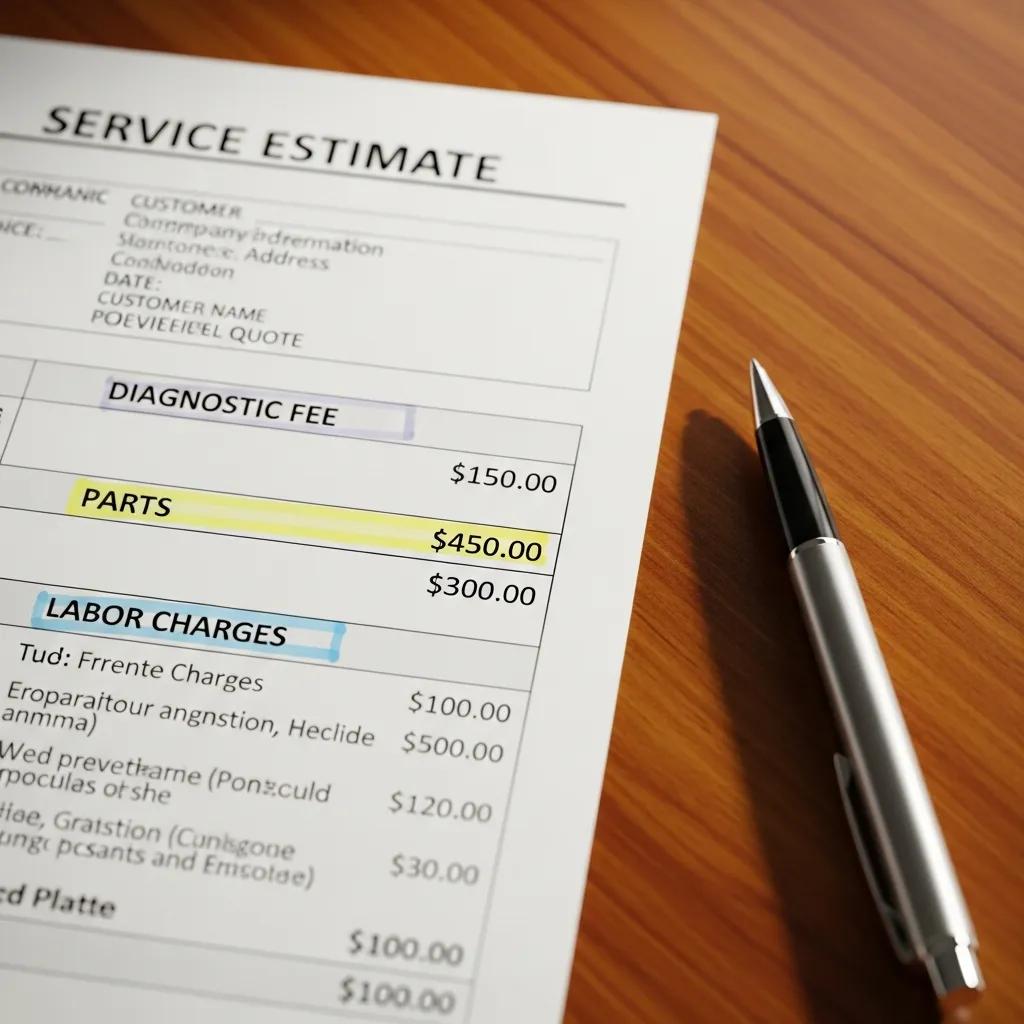
Common components in a service quote include diagnostic fees, replacement parts (filters, compressors, control boards), refrigerant charges, thermostat or control upgrades, and miscellaneous materials. Each line should indicate whether parts are OEM, aftermarket, or reconditioned, because that choice affects price and warranty. For example, a diagnostic fee covers initial troubleshooting and is often credited toward the repair if you proceed. A compressor replacement, by contrast, is typically the largest single parts expense and can multiply the cost of a simple maintenance call. Knowing which items typically appear and why they vary helps you decide whether repair, rebuild, or replacement is the most appropriate option.
To make comparisons easier, use the table below as a line‑item checklist to request from contractors and to compare quotes side by side.
Line item | What to look for | Example / Notes |
|---|---|---|
Diagnostic fee | Is it credited toward repairs? | $75 credited if repairs accepted |
Labor | Hours and rate or flat fee | 2 hours × $120/hr or $240 flat |
Parts | Part number, OEM vs aftermarket | Filter (MERV 8), Compressor (OEM# XYZ) |
Materials & refrigerant | Disposal, recovery, refrigerant type | R‑410A recovery and disposal fee |
Warranty | Duration and covered items | 1‑year parts, 90‑day labor typical |
This template clarifies which fields to expect on a transparent estimate and suggests follow‑up questions when entries are vague. The next subsection explains how labor, parts, and warranty elements are commonly presented and interpreted on estimates.
How Are Labor, Parts, and Warranty Costs Explained in Estimates?
Labor is usually shown as an hourly rate multiplied by estimated hours or as a combined diagnostic and repair flat fee; a good estimate will state the rate, estimated hours, and whether overtime or emergency premiums apply. Parts should include descriptions, quantities, prices, and part numbers—look for OEM vs. aftermarket notes because they indicate quality and warranty differences. Warranties should spell out length, whether labor is covered, and common exclusions like pre‑existing damage or lack of maintenance. Use a short checklist to evaluate these elements: confirm the hourly rate and estimated hours, ask for part numbers and manufacturer warranty details, and get the warranty terms in writing before approving work.
Labor and parts are the main cost drivers, and clear warranty language helps you weigh long‑term value against a lower upfront price. Understanding these distinctions prepares you to read an estimate line by line in the next section.
How Can You Read and Understand Your HVAC Repair Estimate Effectively?
Start by verifying the diagnosis and ensuring the scope of work matches the problem you observed—this confirms the contractor is addressing the right issue. Compare the stated symptoms, the diagnostic findings, and the proposed corrective actions so you can track concept‑to‑cost continuity. Doing this helps prevent scope creep and ensures quoted parts and labor actually address the diagnosed failure. A structured review process removes surprises and makes it easier to normalize multiple quotes.
Use this clear, step‑by‑step decoding process whenever you receive an estimate. Follow the numbered steps to build a consistent review routine.
Verify the scope: Make sure the estimate links the proposed repairs to documented symptoms and diagnostic findings.
Check parts details: Ask for part numbers, OEM vs. aftermarket, and estimated lead times.
Confirm labor math: Request estimated labor hours or flat fees and the contractor’s hourly rate.
Inspect warranty: Read what’s covered, for how long, and which conditions void coverage.
Ask about contingencies: Understand how additional issues will be handled and billed.
In short, this checklist helps you decode costs quickly and gives concrete questions to bring back to the contractor. The table below translates common line items and industry terms you’ll see on estimates.
Estimate item | Typical explanation | What to ask |
|---|---|---|
Markup | Percentage or flat fee added to parts for overhead | Ask what percent or flat fee is applied |
Diagnostic fee | Charge for troubleshooting | Ask if it’s credited when repairs are approved |
Labor estimate | Hours × rate or flat repair fee | Confirm hourly rate and expected hours |
Parts description | Brand, model, and part number | Ask OEM vs. aftermarket and lead time |
Contingency | Placeholder for unknowns discovered during work | Ask what triggers additional charges |
This decoding table turns jargon into actionable questions and helps you request clarifications that prevent disputes. The next subsection explains why visual aids make estimates easier to understand.
What Steps Help Decode HVAC Repair Cost Explanations?
Decoding costs takes targeted action: request a fully itemized invoice, ask for part numbers, get labor hour estimates, and require warranty terms in writing. Start by matching the parts list to the diagnosis, then ask for alternatives if lead times or costs are high. Use short scripts on calls—for example: or Watch for red flags such as single‑line totals without detail or unusually low totals paired with vague descriptions—those often indicate missing items or inferior parts. These steps give you leverage in negotiation and ensure you compare apples to apples across quotes.
A concise five‑step checklist and a couple of short scripts will speed up conversations and get the clarity you need before approving work. The final sub‑section of this H2 explains why tables and diagrams help even more.
How Do Visual Aids Like Tables and Diagrams Enhance Estimate Transparency?
Tables and diagrams turn technical scope into visuals that are easier to interpret, helping you connect costs to specific system components. A labeled system diagram that points out the failed component and the proposed replacement removes ambiguity about what the quote covers. A simple line‑item table with columns for part number, unit price, quantity, and warranty period makes side‑by‑side comparison straightforward. Asking for visuals also tests a contractor’s transparency—providers who include annotated diagrams and clear tables usually follow standardized estimating processes. Visual aids close the gap between technical language and homeowner expectations and create clearer boundaries for the work to be performed.
Request a basic schematic or a part photo reference when the repair is component‑specific; that leads directly into the next major section with precise contractor questions to verify credentials and clarify charges.
What Questions Should You Ask Your HVAC Contractor Before Approving an Estimate?
Before you approve an estimate, focus on questions that confirm credibility, clarify charges, and protect you from surprise costs. The right questions show whether the contractor understands the system, stands behind their work, and will document key terms like payment schedule and warranty. These questions protect your budget and set clear communication expectations so the job proceeds smoothly. Use the quick Q&A below during estimate review calls or meetings.
Are you licensed and insured?: Confirm the contractor holds the appropriate trade license and liability insurance.
Can you provide itemized parts and part numbers?: This verifies the exact components to be used.
What is your labor rate and estimated hours?: Ensures the labor math is transparent.
What warranty covers parts and labor, and how is it documented?: Clarifies protection after service.
What are your payment terms and deposit policy?: Prevents unexpected upfront demands.
This tight set of questions helps you quickly assess whether a contractor’s estimate is reliable and complete. The following subsections cover how to verify credentials and offer scripts for requesting clearer itemization when charges are unclear.
Which Contractor Credentials and Service Details Are Important to Verify?
Key credentials include a valid HVAC license, proof of liability insurance, and local references—these reduce risk and indicate accountability. You can usually verify a license through your state licensing board; ask for an insurance certificate to confirm coverage for property damage or worker injury. References from recent local projects and written guarantees show real‑world performance and local familiarity. Confirming the contractor’s service area and emergency response protocols ensures they can meet timing expectations where you live. Asking for these items before you agree to work protects you from contractors who can’t provide verifiable credentials.
A quick check of license numbers and insurance status gives practical assurance and helps you narrow the field to reputable providers. The next subsection offers scripts and templates for requesting itemized estimates when charges are unclear.
How to Clarify Unclear Charges and Request Detailed Cost Breakdowns?
If charges are unclear, use short, specific scripts to request a detailed breakdown. Example email script: If a contractor resists itemizing, ask why and consider getting additional quotes—refusal to itemize is a red flag. Acceptable responses include a revised estimate listing parts, part numbers, and labor detail, or a written note explaining contingencies and approval thresholds for extra work. If needed, request a cap on total charges or a change‑order process that requires written approval before any added costs are incurred.
A clear script and written follow‑up convert a vague total into a verifiable contract, which prepares you to evaluate regional cost influences in Northern California.
What Regional Factors Affect HVAC Repair Costs in Northern California?
Local labor rates, parts availability, permit requirements, and climate‑driven system stress all influence HVAC repair costs in Northern California. Labor market differences set hourly rates, while supply chain shifts and regional distribution affect part prices and lead times. Climate variations across Sacramento, Elk Grove, and the Central Valley change system load profiles and the types of repairs you’re likely to see. Knowing these regional drivers helps you interpret why identical work can cost different amounts depending on your location.
Understanding recent supply chain and labor trends gives practical guidance on what to ask contractors about lead times and substitute options. The following H3 looks at those trends and actions consumers can take to reduce delays.
How Do Supply Chain and Labor Trends Influence Estimate Pricing?
Equipment shortages, longer part lead times, and higher demand for certified technicians pushed parts prices and labor premiums up in 2023–2024. When supply is constrained, contractors may offer OEM alternatives, longer timelines, or contingency fees for expedited ordering. Labor shortages can mean higher hourly rates or limited scheduling windows, which affects both cost and repair timing. To limit these impacts, ask contractors about lead times, approved substitutes, and scheduling flexibility so you can choose the most cost‑effective and timely option.
Being proactive about lead times and approved alternatives reduces the chance of surprise delays and higher premiums, and that leads into why choosing a local expert matters for accurate quotes.
Why Is Local Expertise Important for Accurate HVAC Service Quotes?
Local expertise improves estimate accuracy because contractors familiar with regional codes, climate conditions, and common equipment types can diagnose problems and specify parts more reliably. A local contractor knows permit requirements, disposal rules, and common failure modes for systems in your micro‑climate, which lowers the risk of an incomplete estimate. Local suppliers and established relationships usually speed parts acquisition and emergency response. Choosing a contractor with proven local experience often yields more accurate timelines and fewer unexpected add‑on charges.
Local knowledge shortens the feedback loop between diagnosis and parts ordering, improving predictability for both cost and schedule. With regional factors covered, the final major section explains how to compare multiple estimates and make an informed approval decision.
How Do You Compare and Approve HVAC Repair Estimates Before Scheduling Service?
Comparing and approving HVAC estimates requires a consistent rubric that normalizes differences in format and highlights real differences in scope, parts quality, labor estimates, and warranty coverage. Start by confirming all quotes address the same scope of work, then normalize for parts (OEM vs. aftermarket), labor hours, and warranty terms. A simple scoring system turns qualitative differences into a numerical comparison so you can choose the best overall value—not just the lowest price. This framework reduces ambiguity and gives you a repeatable method for future quotes.
Below is a sample comparison matrix you can adapt when reviewing multiple contractor estimates.
Contractor | Total estimate | Key differences (Labor / Parts / Warranty) |
|---|---|---|
Contractor A | $X,XXX | Higher labor, OEM parts, 1‑year parts warranty |
Contractor B | $X,XXX | Lower labor estimate, aftermarket part option, 90‑day warranty |
Contractor C | $X,XXX | Mid‑range labor, OEM with extended warranty option |
This matrix helps you see trade‑offs visually and choose based on quality, warranty, and scheduling rather than price alone. The next subsection offers a simple rubric to evaluate quotes and a pre‑scheduling checklist to confirm terms before work begins.
What Criteria Help Evaluate Multiple HVAC Repair Cost Estimates?
Score quotes using criteria such as scope parity, parts specification, labor hours, warranty length, and total cost. Assign weights that match your priorities (for example: scope 30%, parts quality 25%, warranty 20%, labor 15%, total cost 10%) and compute a weighted score to identify the best value. Also factor in contractor responsiveness and verified credentials. This structured method helps you avoid common mistakes like picking a low quote that omits important parts or warranty protections.
A scoring rubric turns subjective impressions into a clear decision metric and prepares you for the scheduling steps after you approve a quote.
How to Schedule Repairs Confidently After Understanding Your Estimate?
When you decide, confirm the work in writing: request a signed service agreement that restates the scope, parts, labor hours, start date, payment terms, and warranty language. Agree on the deposit amount and whether payments are milestone‑based, and set expectations for arrival windows and cleanup. Require a change‑order process that needs written approval for any additional charges beyond a pre‑agreed cap. Finally, get contact information for the job foreperson and confirm post‑service follow‑up for warranty claims or performance checks.
A short pre‑scheduling checklist reduces misunderstandings and establishes clear accountability before technicians arrive. After scheduling, prefer reputable local providers when prompt response and accurate regional pricing matter.
For local help in Northern California, Top Rank Heating and Air Conditioning, Inc. provides detailed repair and service estimates designed to give homeowners clarity before work begins. Top Rank specializes in residential and commercial heating and cooling across Sacramento, Elk Grove, and the Central Valley, and supplies itemized quotes that include parts, labor, timelines, and warranty terms so you can make informed decisions. If you’d like a clear, itemized estimate to compare against other quotes and to schedule repairs with a local provider, contact Top Rank Heating and Air Conditioning, Inc. for a transparent quote and consultation.
Frequently Asked Questions
What should I do if I receive an estimate that seems too low?
If an estimate is significantly lower than others, dig deeper. Low prices can mean omitted tasks, subpar materials, or hidden fees. Ask for a detailed breakdown of what’s included, question parts quality and warranty coverage, and confirm labor assumptions. If the contractor can’t explain or itemize the price, get additional quotes to ensure you’re comparing complete offers.
How can I ensure the contractor is reputable?
Verify licensing and insurance, review online ratings and testimonials, and ask for recent local references—especially for similar jobs. A reputable contractor should readily provide license numbers, insurance certificates, and contactable references. You can also check trade organizations or the Better Business Bureau for additional verification.
What are common red flags to watch for in HVAC estimates?
Look out for vague descriptions, single‑line totals without itemization, refusal to provide part numbers, or unusually low bids compared to others. Also beware of unclear warranty terms or contingency language that leaves pricing open. These signs often indicate a lack of transparency or incomplete scope.
How can I prepare for a contractor's visit to discuss an estimate?
Prepare by reviewing the estimate and listing questions, noting the symptoms you’ve observed, and bringing any previous service records. Research typical repair costs in your area so you have context, and be ready to ask about lead times, part options, and warranty details during the visit.
What should I do if additional issues arise during the repair process?
If new issues appear, request a clear explanation of the findings and how they affect cost and schedule. Make sure any changes are documented in writing, including a revised estimate or change order. Ask for a detailed breakdown of new charges before approving extra work to avoid surprises.
How can I compare estimates from different contractors effectively?
Create a standardized comparison matrix that lists labor costs, parts quality, warranty terms, and total price, and ensure each quote covers the same scope of work. Assign weights to criteria based on your priorities—warranty, parts quality, or total cost—and use that structure to identify the best overall value, not just the cheapest option.
What are the benefits of getting multiple estimates for HVAC repairs?
Getting multiple estimates gives you a clearer market picture, helps you spot omissions or inconsistencies, and provides leverage for negotiation. It also helps you evaluate different approaches—repair versus replace, OEM versus aftermarket—and choose the option that best balances cost, reliability, and warranty protection.
Conclusion
Understanding HVAC repair estimates puts you in control—so you know what you’re paying for, how long the work will take, and what protections you have after the job is done. Use the templates and checklists here to compare quotes, ask the right questions, and pick the contractor that offers the best overall value for your situation. When in doubt, reach out to trusted local experts for a transparent, itemized estimate tailored to your needs. Take the next step toward hassle‑free HVAC repairs by contacting a reputable contractor today.